
Este artículo trata sobre sustancias psicoactivas destinadas a adultos (18+). Consulta a un médico si tienes alguna afección o tomas medicación. Nuestra política de edad
How To Bake Space Cake
Definition
A space cake is a cannabis-infused baked good where THC is extracted into butter or oil before being mixed into batter. Optimal decarboxylation occurs at roughly 110°C over 30–40 minutes (Wang et al., 2016), and oral THC onset takes 30–90 minutes — far slower than inhaled cannabis. Getting both steps right is the difference between a pleasant afternoon and an unpleasant six hours.
18+ only — This guide is written for adults. The dosing calculations and effects described below apply to adult physiology; cannabis edibles are not appropriate for anyone under 18.
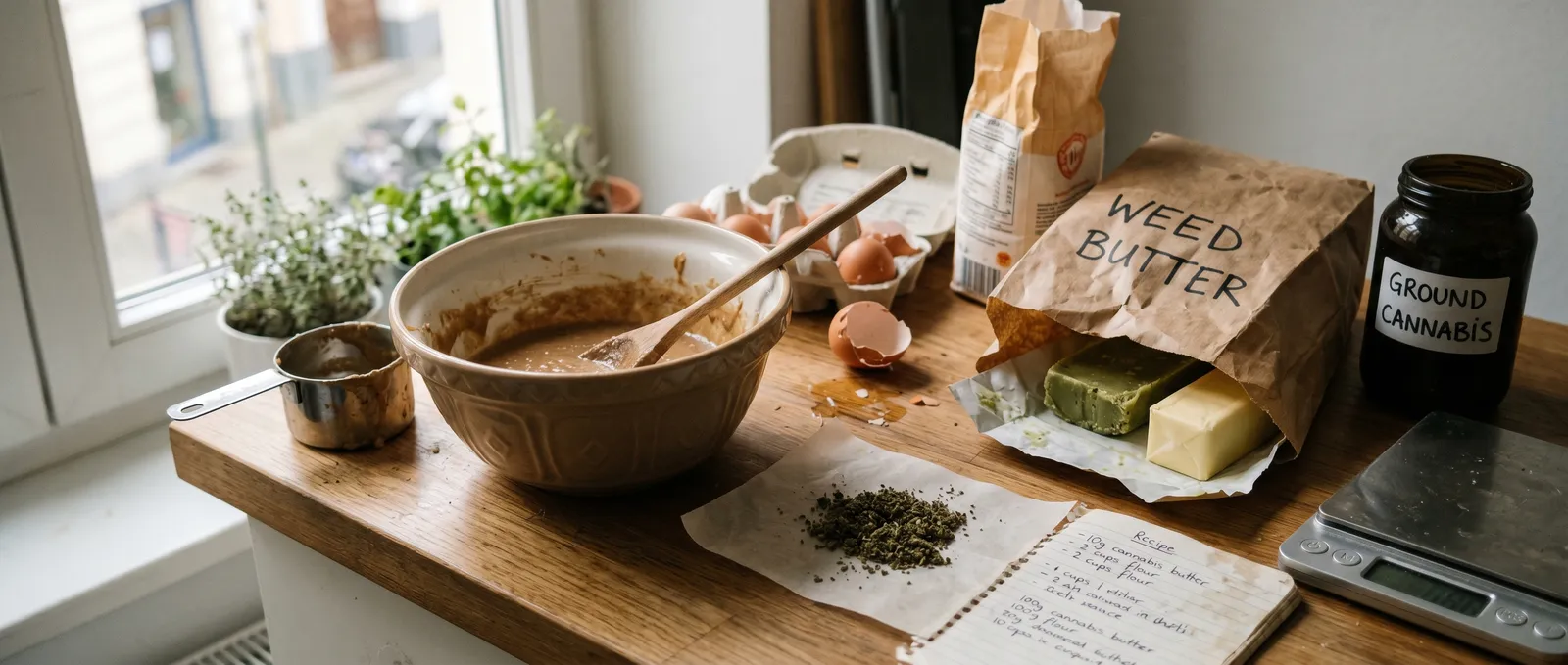
A space cake is a cannabis-infused baked good that delivers THC through a fat-soluble extraction process, typically using butter or coconut oil as the carrier. The concept has deep roots in Amsterdam coffeeshop culture, though the actual execution at home is closer to a chemistry practical than a baking show. Whether you want to buy quality cannabis flower from a trusted source or grow your own, the principles remain the same. Get the decarboxylation wrong and you've made an expensive, slightly grassy chocolate cake. Get the dosing wrong and you're staring at the ceiling for six hours wondering why you didn't just eat half. This guide on how to bake space cake walks you through both pitfalls, step by step.
Before You Start: The Science Bit
Raw cannabis flower contains THCA, not THC, and THCA is non-intoxicating until heat converts it through a process called decarboxylation. THCA needs heat to lose a carboxyl group and convert into the THC that actually binds your CB1 receptors. Decarboxylation is the single most common point of failure in homemade edibles, and understanding how to bake space cake properly begins here. According to Wang et al. (2016), optimal decarboxylation of THCA to THC occurs at approximately 110°C over 30–40 minutes, with significant degradation to CBN (a sedating, less potent cannabinoid) occurring above 150°C. Translation: low and slow wins. Rush the oven and you'll convert your THC into something that mostly just makes you sleepy.
The second critical concept is fat solubility. THC is lipophilic — it dissolves in fats, not water. You can't just crumble flower into cake batter and hope for the best. The THC needs to bind to a fat carrier first. Butter is the classic choice (hence "cannabutter"), but coconut oil works equally well and has a higher saturated fat content, which some bakers argue gives better extraction. Either way, the infusion step is where THC actually enters your recipe.
Step 1: Decarboxylate Your Cannabis
Decarboxylation converts inactive THCA into psychoactive THC by applying low heat over 35–40 minutes. Preheat your oven to 110°C (230°F). Break your dried flower into roughly pea-sized pieces — don't grind it to powder, as fine particles make straining harder later. Spread the pieces evenly on a baking tray lined with parchment paper. Bake for 35–40 minutes, giving the tray a gentle shake at the halfway mark.
You'll know it's done when the flower has turned from green to a light golden-brown colour and the kitchen smells distinctly herbal. If it's going dark brown, your oven runs hot — pull it out. Over-decarbed cannabis tastes harsh and has lost potency to CBN conversion. An oven thermometer, which you can buy at Azarius alongside digital scales and other accessories, helps you verify your actual oven temperature rather than trusting the dial.
Tip: If smell is a concern, seal the cannabis in an oven-safe bag or wrap the tray tightly with aluminium foil. It won't eliminate the aroma entirely, but it reduces it by roughly half.
Step 2: Infuse Your Fat (Cannabutter or Canna-Oil)
Cannabutter is made by simmering decarboxylated flower in butter and water on the lowest possible heat for 2–3 hours, extracting THC into the fat. You need:
- Your decarboxylated cannabis (see dosing section below for how much)
- 250g unsalted butter or 240ml coconut oil
- 240ml water (prevents the butter from scorching)
Combine the butter (or oil), water, and decarbed cannabis in a saucepan over the lowest heat your hob can manage. You want a very gentle simmer — tiny bubbles, not a rolling boil. Maintain this for 2–3 hours, stirring every 20 minutes or so. The water prevents the temperature from exceeding 100°C, which protects the THC from degradation.
After simmering, strain the mixture through a cheesecloth or fine mesh sieve into a glass container. Squeeze the cloth to get every last drop of infused fat — that's where your THC lives. If you used butter, refrigerate the container. The butter will solidify on top of the water; once firm, poke a hole in the butter disc, drain the water, and pat the butter dry. Your cannabutter is ready.
There's a persistent debate among the staff about whether simmering for 2 hours versus 3 makes a real difference. One colleague swears the third hour adds a heavier body effect; another insists it just adds bitterness. Honestly, the published data doesn't settle it — most extraction studies use standardised lab conditions that don't map neatly to a Dutch kitchen hob. Two hours is the safe minimum. Three won't ruin anything.
Step 3: Calculate Your Dose
A standard beginner dose of THC in a space cake is 5–10mg per serving, and getting this right requires simple arithmetic rather than guesswork. According to Barrus et al. (2016) in their review of cannabis edible pharmacokinetics for the Oregon Health Authority, experienced users might go up to 25–50mg, but if you're baking for a group with mixed experience levels, aim low.
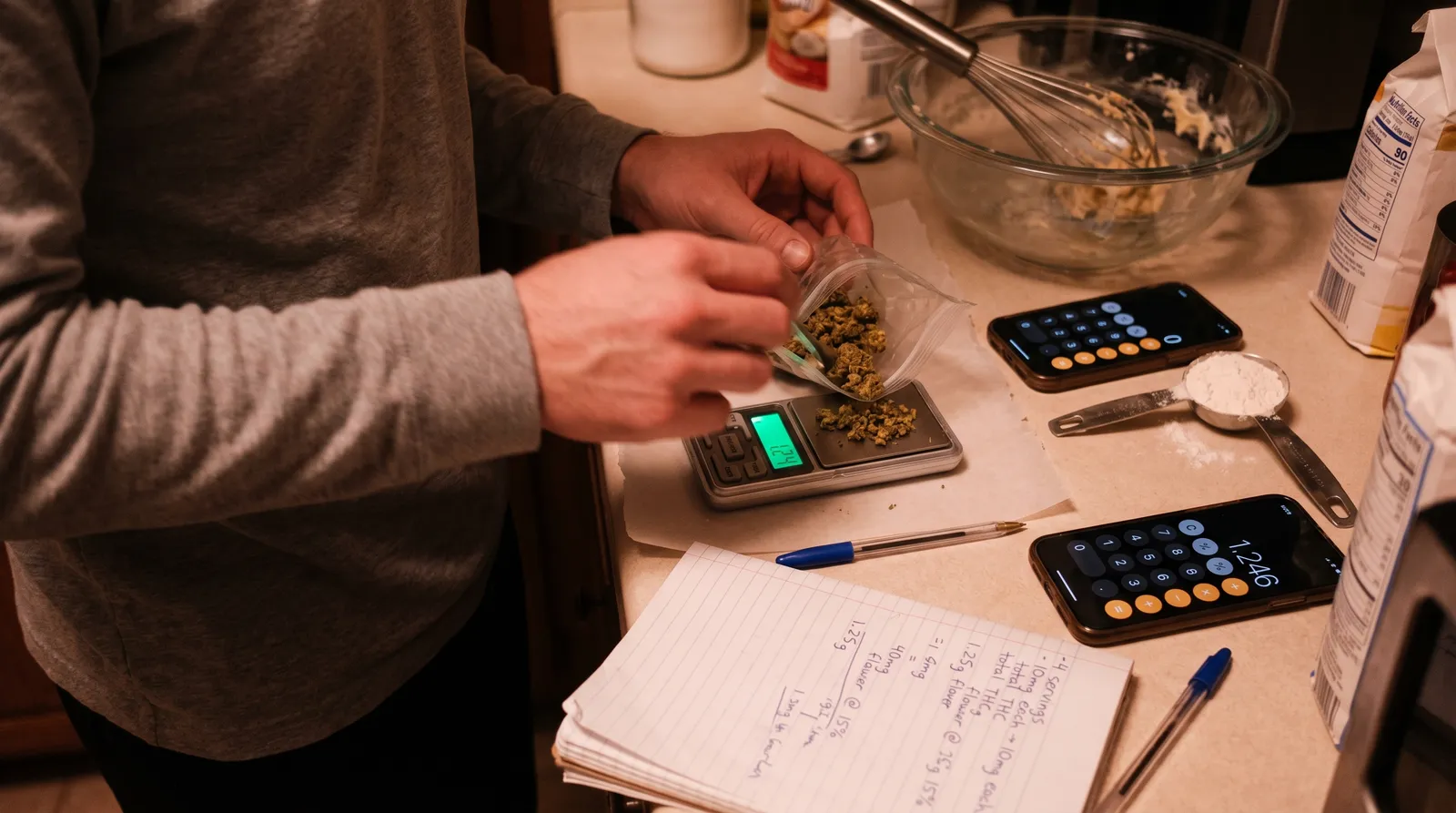
Here's the calculation:
| Variable | Example | Your Batch |
|---|---|---|
| Grams of flower used | 3g | ___ |
| THC percentage of your strain | 18% | ___ |
| Total THC in mg (grams × % × 1000) | 3 × 0.18 × 1000 = 540mg | ___ |
| Extraction efficiency (assume ~80%) | 540 × 0.8 = 432mg | ___ |
| Number of servings | 12 slices | ___ |
| THC per serving | 432 ÷ 12 = 36mg | ___ |
In the example above, 36mg per slice is a strong dose — fine for experienced users, but a beginner should eat a third of a slice and wait. If you want 10mg per serving across 12 slices, you need about 120mg of extractable THC, which works out to roughly 0.8–1g of 18% flower. For a full cake that serves 8–10 people at a moderate 15–20mg each, 2–3g of mid-strength flower is a reasonable starting point.
The 80% extraction efficiency figure is an estimate — home kitchen methods vary, and real-world efficiency might be anywhere from 60% to 90% depending on temperature control, simmer time, and how thoroughly you strain. If you're learning how to bake space cake for the first time, err on the side of less cannabis. You can always eat more cake. You cannot un-eat cake.
Step 4: Bake the Cake
Baking a space cake uses the same method as any standard chocolate cake, with cannabutter replacing regular butter. Use any chocolate cake recipe you trust — the cannabis flavour pairs best with chocolate, coffee, or spice-heavy batters that can mask the herbal taste. Here's a straightforward one:
Ingredients:
- 125g cannabutter (from Step 2)
- 200g caster sugar
- 2 large eggs
- 200g plain flour
- 50g cocoa powder
- 1 tsp baking powder
- ½ tsp bicarbonate of soda
- Pinch of salt
- 120ml buttermilk (or milk with a squeeze of lemon)
- 1 tsp vanilla extract
Method:
- Preheat your oven to 175°C (350°F). Grease and line a 20cm round tin or a standard loaf tin.
- Cream the cannabutter and sugar together until pale and fluffy — about 3–4 minutes with an electric mixer, longer by hand.
- Beat in the eggs one at a time, adding a tablespoon of flour with each to prevent curdling.
- Sift together the remaining flour, cocoa powder, baking powder, bicarb, and salt.
- Fold the dry ingredients into the wet mixture in three additions, alternating with the buttermilk. Don't overmix — stop as soon as the streaks of flour disappear.
- Pour into the prepared tin and bake for 25–35 minutes. A toothpick inserted in the centre should come out with just a few moist crumbs, not wet batter.
- Cool in the tin for 10 minutes, then turn out onto a wire rack.
The oven temperature of 175°C is well above the decarboxylation threshold, but your THC is already safely dissolved in fat and protected within the batter matrix. Some minor degradation occurs — estimates range from 10–15% loss during baking — but this is already accounted for in the rough dosing maths above.
Step 5: Portion, Label, and Wait
Edible cannabis takes 30–90 minutes to produce noticeable effects, so patience after eating is the most important ingredient in any space cake experience. Cut the cake into equal portions and, if you're sharing, label them clearly. This isn't paranoia — it's basic harm reduction. An unlabelled cake in a shared kitchen is an accident waiting to happen. Write the approximate mg per slice on a sticky note and attach it to the container.
According to Huestis (2007), oral THC typically takes 30–90 minutes to produce noticeable effects, with peak plasma concentrations occurring 1–3 hours after ingestion. This is dramatically different from inhaled cannabis, where effects begin within minutes. The number one mistake with edibles — and this is backed by data from Vandrey et al. (2017) — is redosing before the first dose has peaked. Eat your portion, set a timer for 90 minutes, and do something else. If you feel nothing after two full hours, consider eating another small piece. Never double your dose on the first attempt.
Effects from edibles typically last 4–8 hours, with some residual grogginess the following morning at higher doses. Eating on a full stomach slows onset further; eating on an empty stomach intensifies and accelerates it.
Common Mistakes and How To Avoid Them
The most frequent cause of failed space cake is skipping decarboxylation entirely, which leaves THCA unconverted and the cake non-psychoactive. Below are the top errors and their fixes:
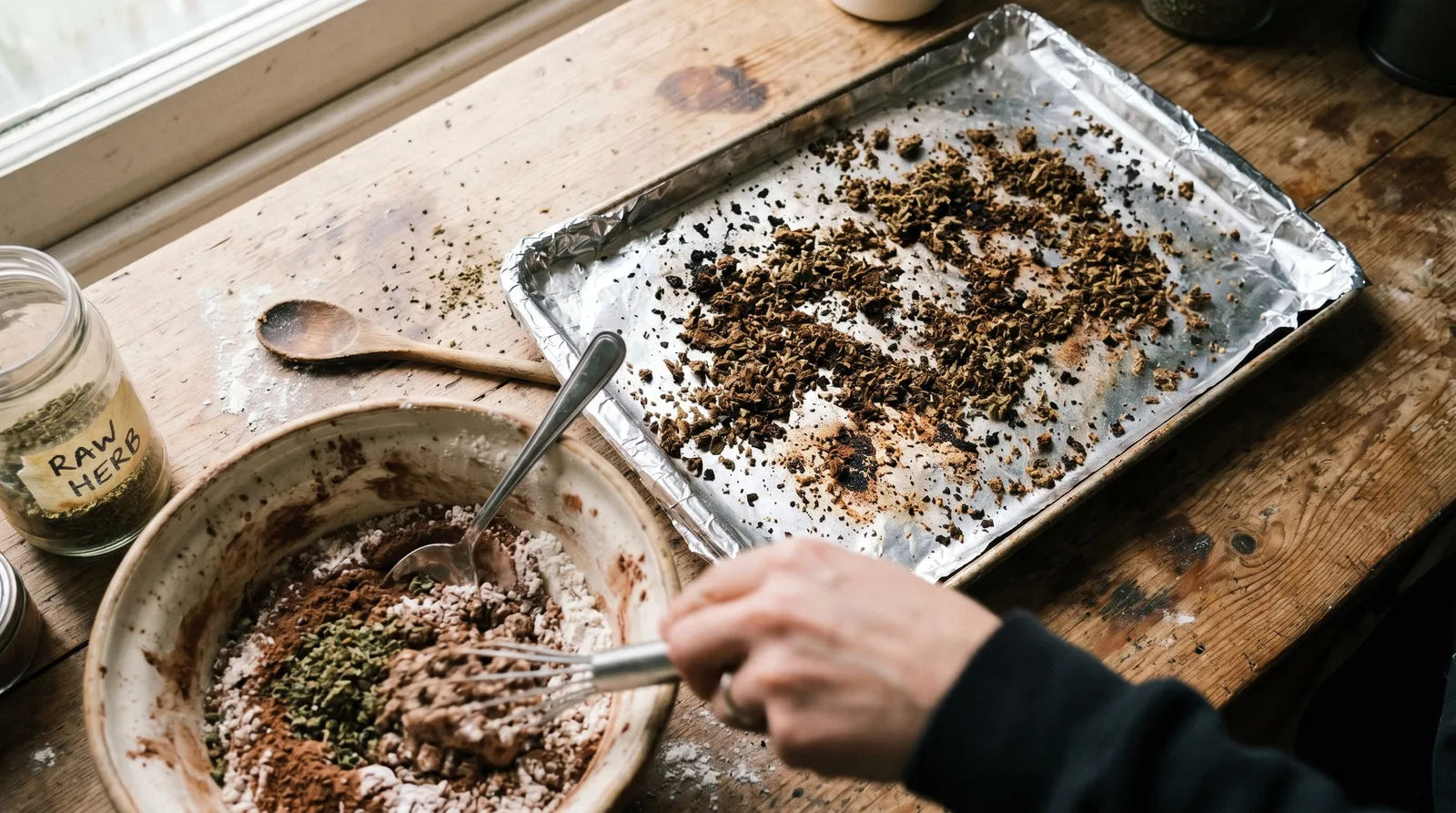
- Skipping decarboxylation. Raw flower in batter = wasted cannabis. Always decarb first.
- Grinding too fine. Powder passes through cheesecloth and adds a gritty, bitter texture to the final cake. Coarse pieces strain cleanly.
- Overheating the butter. If your infusion is bubbling vigorously, it's too hot. THC degrades above 150°C. Keep it at a bare simmer.
- Uneven mixing. If the cannabutter isn't evenly distributed in the batter, some slices will be significantly stronger than others. Cream the butter thoroughly and fold the batter well.
- Not waiting long enough. Oral cannabis hits slower and harder than inhaled. The "it's not working" redose is responsible for most bad edible experiences.
- Storing without labels. Edibles look identical to regular baked goods. Label everything, and store away from children and pets.
Vegan and Dietary Variations
Coconut oil is the best butter substitute for vegan space cake, and it often produces a cleaner taste than dairy-based cannabutter. For a vegan version, swap the butter for coconut oil (infuse it the same way), replace eggs with 2 tablespoons of ground flaxseed mixed with 6 tablespoons of water (let it sit for 5 minutes to gel), and use plant-based milk with a splash of apple cider vinegar in place of buttermilk. The coconut oil version actually tends to have a slightly cleaner taste, as dairy butter can amplify the herbal notes.
For a gluten-free version, substitute the plain flour with a 1:1 gluten-free baking blend. Add an extra ½ teaspoon of xanthan gum if your blend doesn't already include it — this keeps the crumb from turning sandy.
Space Cake vs Other Edible Methods
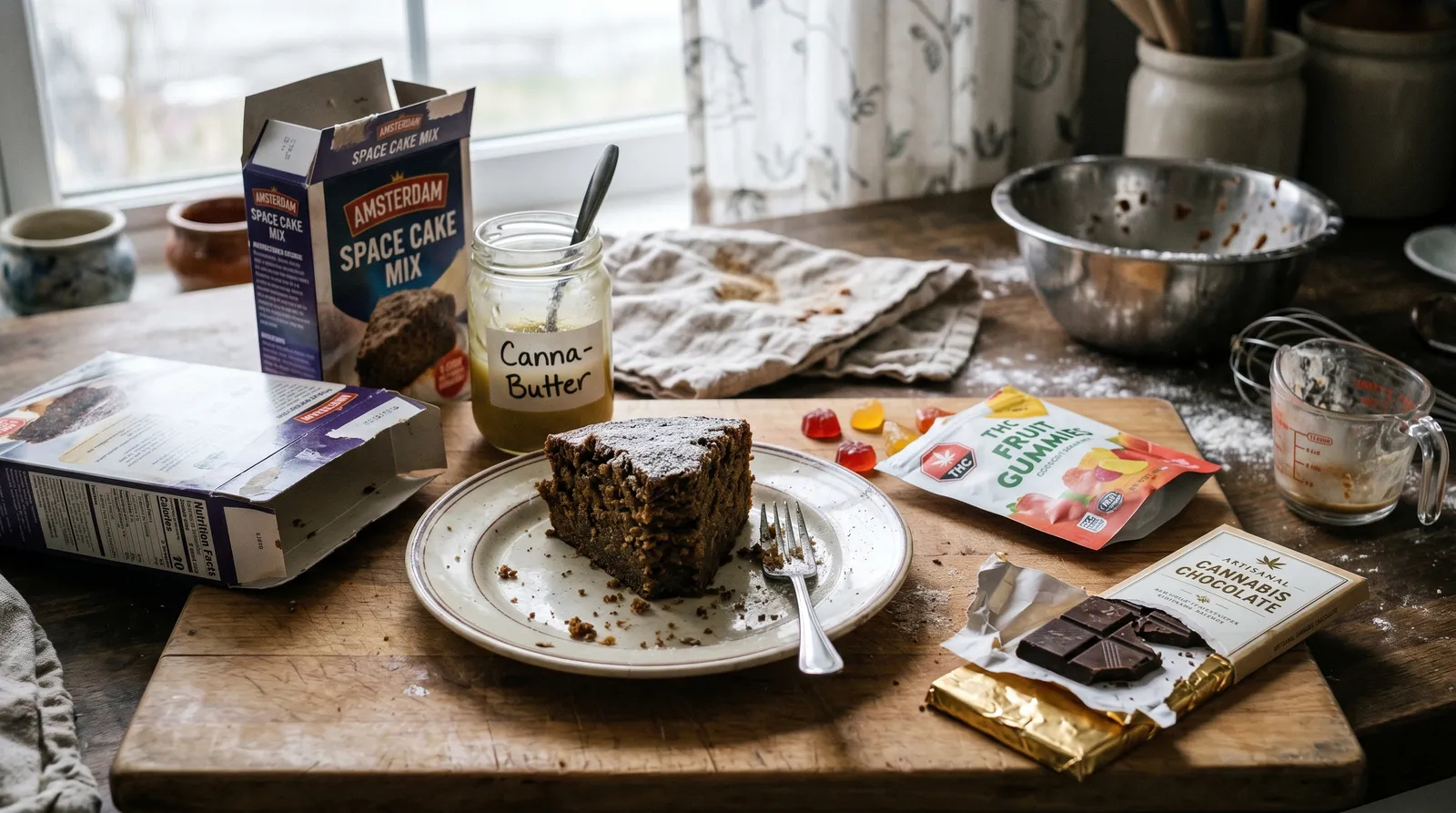
Space cake is the most traditional cannabis edible, but it is not the most precise — and understanding the trade-offs helps you choose the right method. Cannabis-infused gummies and chocolates, which you can buy from many coffeeshops and online retailers, offer more precise dosing because each piece is manufactured to contain a specific milligram amount. Space cake, by contrast, relies on your mixing being perfectly even — which it rarely is in a home kitchen. On the other hand, when you bake space cake at home you get to choose your strain, control your ingredients, and avoid the additives found in some commercial products.
Cannabis capsules are another option: you fill gel caps with canna-oil, giving you pharmaceutical-style dosing without any baking at all. The downside is that capsules lack the ritual and social aspect of sharing a cake. Tinctures (alcohol-based cannabis extracts) offer faster sublingual absorption but a very different experience profile. For most people learning how to bake space cake at home, the butter-infusion method described above remains the most accessible and forgiving starting point.
We've had customers order cannabis grinders and then come back a week later saying their space cake didn't work. Nine times out of ten, they ground the flower to dust, which made straining impossible and left plant matter throughout the batter — bitter, gritty, and underdosed because half the cannabutter stayed trapped in the cheesecloth. Pea-sized pieces. We can't stress this enough.
Essential Tools for Space Cake Baking
Precise temperature and weight measurement are the two factors that separate a well-dosed space cake from a guessing game. You don't need professional kitchen equipment, but a few specific tools make the process dramatically more reliable.
A digital kitchen scale accurate to 0.1g is essential for weighing your flower — eyeballing 2g versus 3g can mean the difference between a mellow dose and an overwhelming one. An oven thermometer is equally important, since most home ovens drift 10–15°C from their displayed temperature, and that drift matters during decarboxylation. A fine mesh strainer or cheesecloth is non-negotiable for separating plant material from your infused fat. You can buy digital scales, herb grinders, and oven thermometers from the Azarius accessories range. A standard kitchen timer rounds out the essentials — use it for both the decarb step and the 90-minute post-eating wait.
One of our regulars bought a cheap oven thermometer after his second failed batch and discovered his oven was running 20°C hotter than the dial said. His decarb had been happening at 130°C, not 110°C — enough to start converting THC to CBN. After calibrating, his third attempt worked perfectly. A €5 thermometer saved him a lot of wasted flower.
What We Still Don't Know
The home-edibles space is surprisingly under-researched, which means all dosing calculations should be treated as educated estimates rather than guarantees. Most published cannabinoid pharmacokinetic studies use standardised oral doses (Marinol capsules or measured oil extracts) rather than actual baked goods, which means the absorption data we cite from Huestis (2007) and Vandrey et al. (2017) may not perfectly reflect what happens when THC is bound in a flour-sugar-fat matrix and passes through your gut. The EMCDDA (European Monitoring Centre for Drugs and Drug Addiction) has flagged the lack of standardised edible research as a gap in their risk assessments. We also don't have great data on how different ovens, altitudes, and batter densities affect THC degradation during baking. The 10–15% loss figure is widely repeated but thinly sourced. Until better kitchen-specific studies exist, treat all dosing calculations as educated estimates, not guarantees.
A Note on Interactions
Cannabis edibles interact with at least 404 known medications, including 28 classified as major interactions, making it essential to check before consuming. Drugs.com lists notable interactions with benzodiazepines (such as alprazolam), SSRIs, and blood thinners. The Azarius wiki article on cannabis drug interactions covers the specifics in depth. The short version: THC is metabolised by CYP3A4 and CYP2C9 liver enzymes, and anything that competes for those pathways can alter both the drug's and THC's effects unpredictably. The Beckley Foundation has also published research on cannabinoid metabolism that supports caution when combining edibles with prescription medication.
Last updated: April 2026
Preguntas frecuentes
8 preguntasHow much cannabis should I put in a space cake?
How long does it take for space cake to kick in?
Why didn't my space cake work?
Can I make space cake without butter?
How do I calculate THC dosage in homemade edibles?
Where can I buy ingredients for space cake?
What temperature should I decarboxylate cannabis at for space cake?
Can I use coconut oil instead of butter for space cake?
Sobre este artículo


Joshua Askew serves as Editorial Director for Azarius wiki content. He is Managing Director at Yuqo, a content agency specialising in cannabis, psychedelics and ethnobotanical editorial work across multiple languages. Th
Este artículo wiki se ha redactado con ayuda de IA y ha sido revisado por Joshua Askew, Managing Director at Yuqo. Supervisión editorial a cargo de Adam Parsons.
Aviso médico. Este contenido es únicamente informativo y no constituye asesoramiento médico. Consulta a un profesional sanitario cualificado antes de consumir cualquier sustancia.
Última revisión 2 de mayo de 2026
References
- [1]Russo, E. B. (2011). Taming THC: potential cannabis synergy and phytocannabinoid-terpenoid entourage effects. British Journal of Pharmacology, 163(7), 1344-1364. DOI: 10.1111/j.1476-5381.2011.01238.x
- [2]MacCallum, C. A., & Russo, E. B. (2018). Practical considerations in medical cannabis administration and dosing. European Journal of Internal Medicine, 49, 12-19. DOI: 10.1016/j.ejim.2018.01.004